Breeding program for quinoa (Chenopodium quinoa) using landraces for breeding improved varieties in the highland from Peru
Flavio Lozano-Isla1, Jose David Apaza-Calcina2, Angel Mujica-Sanchez2, Bettina I.G Haussmann3, Karl J. Schmid1
-
Department of Crop Biodiversity and Breeding Informatics, Faculty of Agriculture, University of Hohenheim, Stuttgart, Germany
-
Quinoa Breeding Program, Universidad Nacional del Altiplano-Puno, Puno, Perú
-
Institute of Plant Breeding, Seed Science and Population Genetics, University of Hohenheim, Stuttgart, Germany
Introduction
Quinoa (Chenopodium quinoa Willd.) is an ancient crop from the Andean region and a staple food for smallholder farmers in the highlands. For centuries, Andean farmers have been involved in the domestication and selection of quinoa varieties. Quinoa is tolerant to a diverse range of abiotic stresses and has good nutritional properties, which have made it attractive around the world as a new crop for food security and that can cope with Climate Change. At present, there is a great demand for the development of new quinoa varieties with higher yields; adapted to new habitats and adverse conditions of Climate Change, and with tolerance to biotic and abiotic stresses.
Objectives
- To develop a breeding program in the Peruvian Andean highlands region with the collaboration of the smallholder farmers.
- To use simple crosses methodology with six quinoa landraces (Salcedo INIA, Pasankalla, Kcancolla, Huariponcho, Negra Collana and Pandela Rosada).
- To select promising lines with good agronomic qualities, different grain colors and high yields to be released in 2020 as new cultivars to be used by smallholder farmers in Peru.
Materials and Methods
Genetic material
The lines were originated from the simple crosses of 6 varieties (Salcedo INIA, Pasankalla, Kcancolla, Huariponcho, Negra Collana and Pandela Rosada), which are the most planted in Peru.
Evaluations
The variables evaluated during flowering and maturity were: panicle length (cm), panicle diameter (cm), stem diameter (cm), plant high (cm) yield components (g) and resistance to mildew (scale)-
Selection
In the F9 generation, 90 lines by cross were planted with the 6 parentals and 4 checks. After the data analysis, 3 lines by cross were selected. The 18 selected lines were planted in Arequipa for seed propagation with 3 checks under a drip irrigation system.
Locations and Management
The lines were planted in 3 locations for the season of 2017 to 2018: Illpa and Camacani in Puno and San Juan de Yanamuclo in Jauja, The experiments were carried out in field conditions, with row distance of 0.6 m and row length of 5 m with plot area of 5 m2.
Data analysis
The experiments had a lattice design of 10x10 with 2 replication by cross. The data was submitted for a multivariate analysis for PCA (Husson et al. 2018), and for the lines selection it was used the multivariate Elston Index (Elston 1963).
Album web
Contact
✉ Flavio Lozano Isla
flavjack@gmail.com
✉ Karl J. Schmid
karl.schmid@uni-hohenheim.de

Scan this QR code to visit this poster online!
Results
| Location | Camacani, Puno | Illpa, Puno | Jauja, Junin |
|---|---|---|---|
| Latitud | 15°56’54.45” | 15°42’49.24” | 11°51’21.9” |
| Longitud | 69°51’31.13” | 70°4’20.33” | 75°23’43.01” |
| Altitude (masl) | 3842 | 3815 | 3322 |
| Maximum annual rainfall (mm) | 169.6 | 197.7 | 124 |
| Minimum annual rainfall (mm) | 26.8 | 29.8 | 5 |
| Maximum temperature (°C) | 17.4 | 20.4 | 19.1 |
| Minimum temperature (°C) | 2.5 | -0.4 | 0.8 |
| Soil type | Sandy clay loam | Silty clay | Clay |
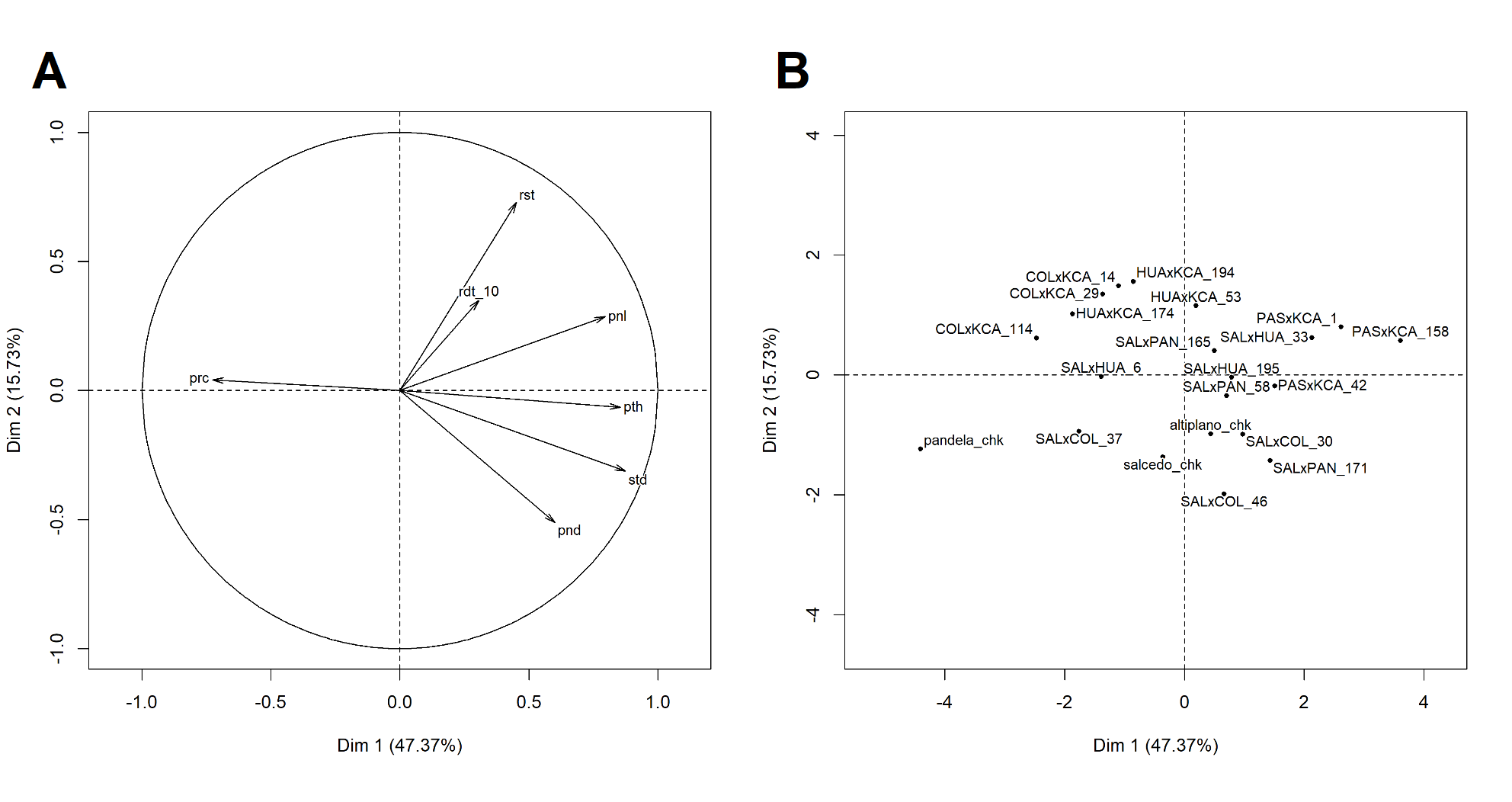
Principal Component Analysis for the 3 location. A) variables and B) Individual
Discussions and Conclusions
The present breeding program is centered in developing new quinoa cultivars focused on smallholder farmers using the traditional technology and apply new cultural activities such as furrowing and density control that can help them to improve crop yield, many times the breeding programs invest in developing improved varieties for large-scale agribusinesses, but breeding programs are not tailored to the needs of smallholders (Gamboa et al. 2018). The breeding program in the Peruvian highlands has been achieved improved lines with good agronomic qualities and tolerant to biotic and abiotic stresses and farmers learned how to improve their quinoa production applying cultural activities.
Acknowledgements
The authors want to thank Prof. Dr. Raul Blas Sevillano from UNALM, for his advice and support during the project. The students Ana Lucia Ortega and Miguel Palacios from UNALM and Blander Mamani and Maritza Salazar from UNAP for their help in the experiments development, and to the farmers that made possible this project and KWS seed company for the funds for the project and my fellowship for my doctoral studies.
Refereces
Elston, RC. 1963. A Weight-Free Index for the Purpose of Ranking or Selection with Respect to Several Traits at a Time. Biometrics 19(1):85-97. DOI: https://doi.org/10.2307/2527573.
Gamboa, C; Van den Broeck, G; Maertens, M. 2018. Smallholders’ Preferences for Improved Quinoa Varieties in the Peruvian Andes. Sustainability 10(10):3735. DOI: https://doi.org/10.3390/su10103735.
Husson, F; Josse, J; Le, S; Mazet, J. 2018. FactoMineR: Multivariate Exploratory Data Analysis and Data Mining (en línea). s.l., s.e. Disponible en https://CRAN.R-project.org/package=FactoMineR.